Brand inconsistency is a silent revenue killer. A prospect sees your LinkedIn ad, visits your website, receives a nurture email, and encounters your retargeting campaign — and each touchpoint feels like it came from a different company. The messaging drifts. The tone shifts. The visual language diverges. By the time they reach a sales conversation, the brand impression is blurry at best.
For enterprise marketing leaders managing multi-channel strategies across distributed teams, this isn't a hypothetical. It's Tuesday.
The good news: AI-driven marketing orchestration has matured to the point where brand consistency at scale is no longer a matter of more headcount, more reviews, or more brand guidelines that nobody reads. It's a matter of architecture — how you design your marketing motion from the ground up.
This guide walks through the practical strategies senior marketing leaders can use to engineer consistent, autonomous, and measurable brand execution across every channel.

Why Brand Consistency Fails at Scale
Before designing a solution, it's worth diagnosing the actual problem. Brand inconsistency at the enterprise level rarely comes from carelessness. It comes from structural fragmentation.
The root causes are predictable:
Siloed channel ownership. When your email team, paid media team, content team, and social team operate independently, each optimizes for its own KPIs — often at the expense of a unified narrative.
Distributed content creation. When multiple writers, agencies, or tools produce content without a shared intelligence layer, voice drift is inevitable.
Reactive workflows. When teams respond to performance data in isolation, messaging pivots channel-by-channel rather than brand-wide.
Tool sprawl. When strategy, creation, publishing, and measurement live in separate platforms, there's no single source of truth for what "on-brand" actually means in execution.
The result is a fragmented marketing motion — one where each channel is technically active, but none are working together toward a coherent brand experience.

The Architecture Principle: Unifying Strategy, Creation, and Measurement
The most effective AI-powered approach to brand consistency isn't about automating individual tasks. It's about unifying the entire marketing loop — from strategic planning through content creation, publishing, performance measurement, and optimization — within a single intelligent system.
Think of it as building a centralized brand intelligence layer that every piece of content flows through, regardless of channel or format.
This architecture has three foundational components:
1. A Persistent Brand IQ
Traditional brand guidelines are static documents. They describe what a brand sounds like in theory but offer no enforcement mechanism in practice. An AI-powered system goes further by building a dynamic Brand IQ — a continuously updated model of your brand's voice, audience positioning, messaging priorities, and content performance patterns.
This isn't a one-time setup. Every piece of content created, every campaign that runs, and every performance signal that comes back from the market feeds the model. Over time, the system doesn't just follow guidelines — it learns what resonates with your specific audience and reinforces that learning across every channel.
For enterprise marketing leaders, this means the definition of "on-brand" evolves intelligently as your market does, rather than calcifying in a PDF that was last updated two years ago.
2. A Unified Content Workflow
Multi-channel consistency breaks down most often at the creation and publishing layer. When each channel has its own workflow, inconsistency is baked into the process itself.
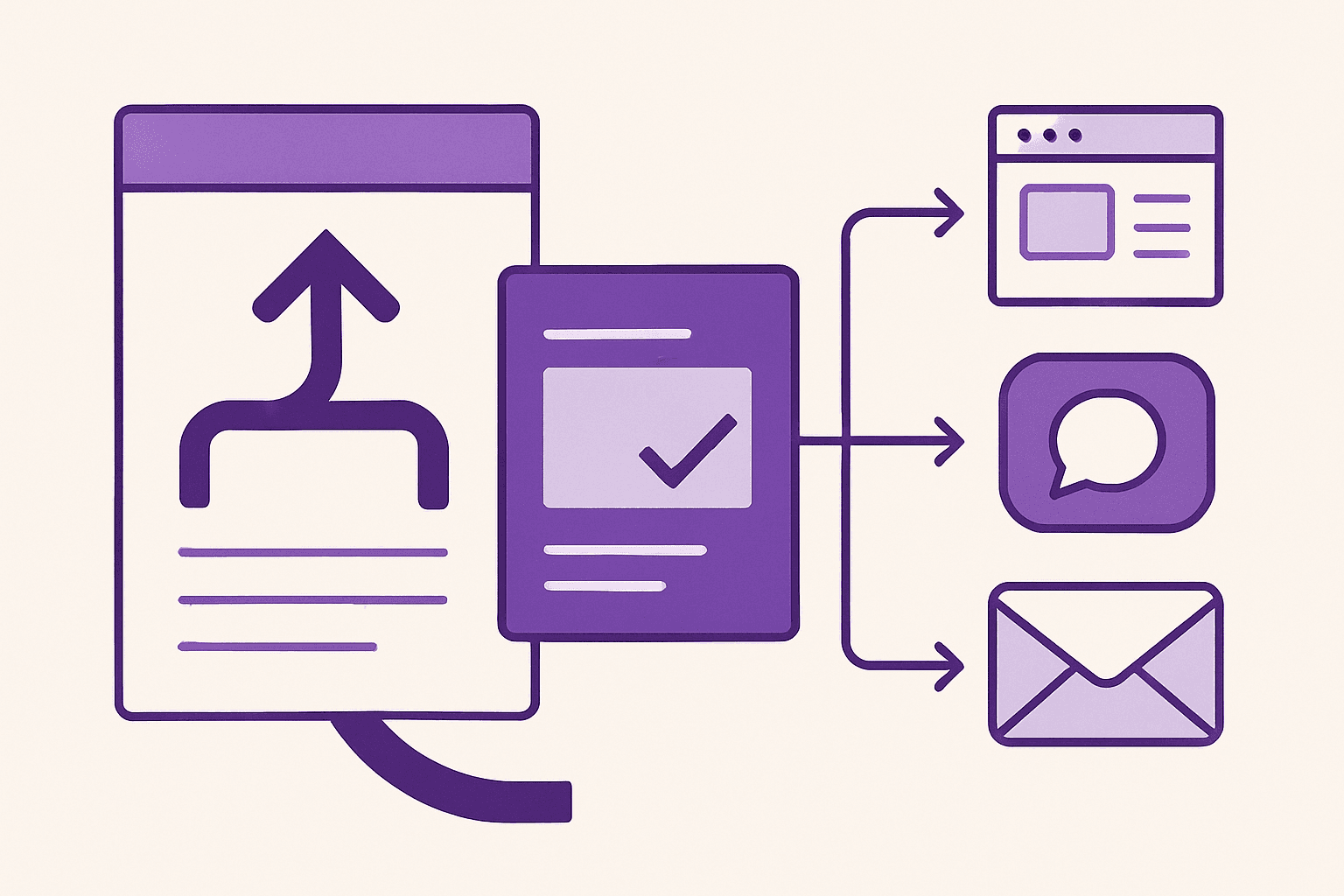
An effective AI marketing workflow connects strategy directly to execution. Content plans are generated from the same strategic inputs that inform your brand positioning and audience priorities. When a campaign theme is defined at the strategy level, it propagates consistently into blog posts, social copy, email sequences, and ad creative — not as a manual briefing exercise, but as a structural output of the system.
Key characteristics of a unified content workflow:
Single source of strategy. Campaign goals, audience segments, and messaging frameworks are set once and inherited by all downstream content.
Format-aware creation. The same strategic brief produces channel-appropriate content — an in-depth blog post, a condensed LinkedIn post, a direct-response email — without losing the core brand narrative.
Native publishing with field-level control. Content flows directly to CMS, social, email, and ad platforms through mapped integrations, eliminating the manual hand-off steps where brand details get lost in translation.
3. Closed-Loop Performance Intelligence
The final architectural layer is what separates a functional multi-channel strategy from a self-optimizing one. A closed-loop system connects your publishing activity to your performance data — and feeds that data back into your planning process.
In practice, this means your AI-driven marketing system is continuously analyzing signals from Meta Ads performance, Search Console rankings, email engagement rates, and social reach, then adjusting content plans and messaging priorities based on what's actually working. Brand consistency isn't just maintained across channels — it's refined in response to real market feedback.
This is the operating model of marketing loop optimization: plan, create, publish, measure, adjust — continuously, at scale, without requiring a human to manually close the loop each cycle.
Practical Strategies for Implementation
Understanding the architecture is one thing. Operationalizing it inside a complex marketing organization requires a phased, deliberate approach.
Start with a Brand Audit Across Channels
Before implementing any AI system, conduct a qualitative audit of your current brand expression across every active channel. Pull representative content samples from email, paid social, organic social, blog, and any other active touchpoints. Evaluate them against three dimensions: voice consistency, messaging alignment, and visual coherence.
The gaps you identify aren't just a content problem — they're a process and systems problem. The audit reveals where the architecture is broken, which tells you where to focus your integration efforts first.
Centralize Brand Inputs Before Scaling Output
A common mistake is deploying AI content tools to increase output volume before establishing centralized brand inputs. The result is more content that's consistently inconsistent — the fragmentation just happens faster.
Prioritize establishing your brand intelligence layer first: voice guidelines, audience definitions, messaging hierarchies, and campaign-level strategic objectives. Once that foundation is in place, scaling output through an AI workflow preserves consistency because every piece of content draws from the same source of truth.
Map Your Channel Relationships Deliberately
Not every channel serves the same role in your marketing motion. Organic search content serves a different strategic function than paid social retargeting, which is different from email nurture sequences. Architecting brand consistency doesn't mean all channels sound identical — it means they tell a coherent story from their respective positions in the funnel.
Define how your channels relate to each other strategically:
Which channels are responsible for awareness and top-of-funnel brand building?
Which channels are responsible for conversion and direct-response messaging?
Where does long-form thought leadership sit relative to short-form social content?
How do paid and organic channels reinforce rather than contradict each other?
When these relationships are explicitly defined within your marketing workflow, your AI system can generate channel-appropriate content that reinforces the same strategic narrative from different angles — rather than simply repurposing one format into another.
Implement Autonomous Publishing with Oversight Checkpoints
Full marketing orchestration through AI doesn't mean removing human judgment from the process. It means repositioning where that judgment is applied — at the strategic and review level, rather than the execution level.
An effective autonomous marketing workflow operates on a cadence: content is planned, created, and staged for publishing automatically. Human review focuses on strategic alignment and quality thresholds, not on writing from scratch or manually scheduling posts across platforms.
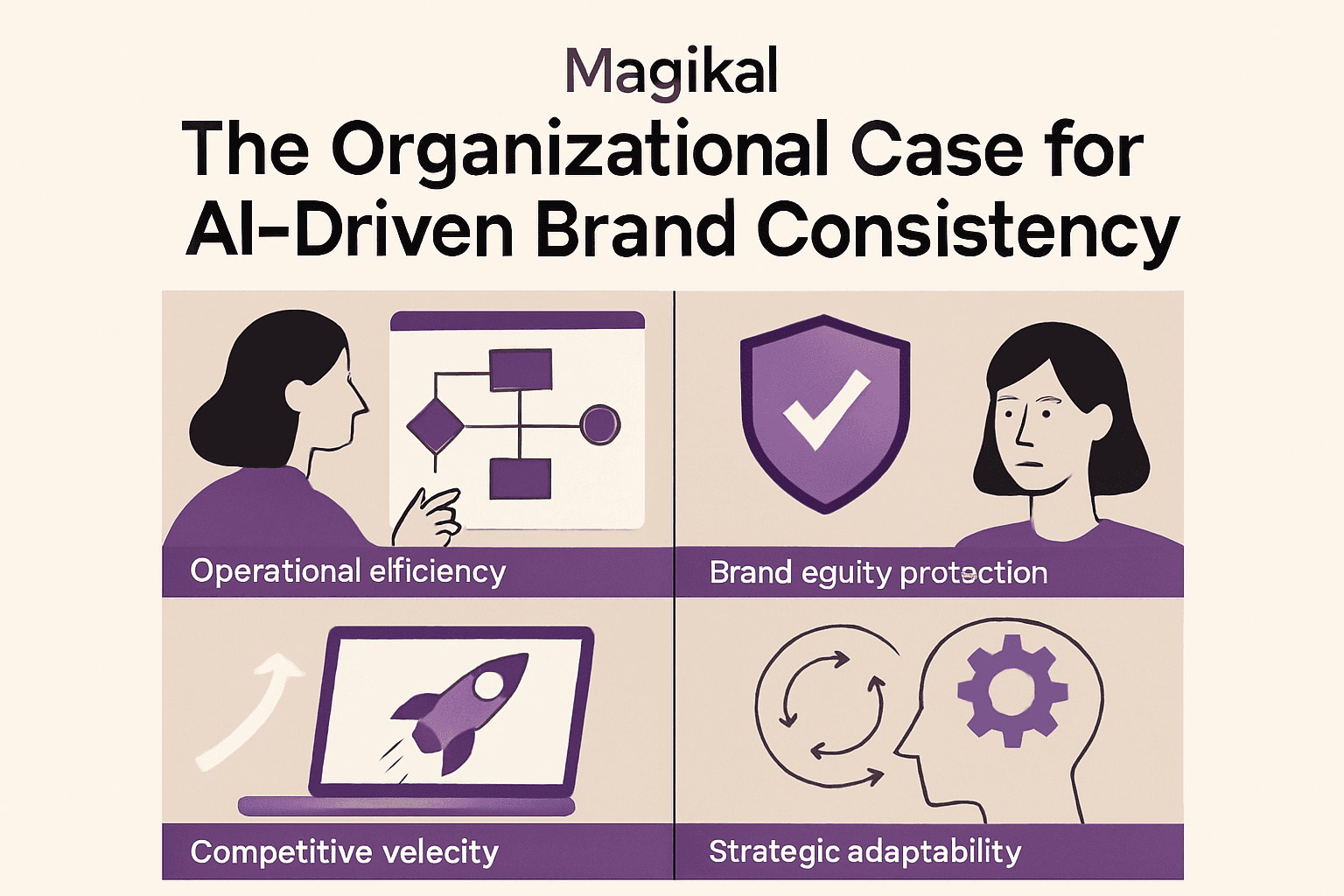
This is the operational efficiency unlock for lean and enterprise teams alike. Your senior marketing leaders spend time on decisions that require strategic judgment. The AI system handles the execution volume that previously consumed that capacity.
Build Performance Feedback Into the Planning Cycle
Marketing teams that operate without a structured feedback loop make the same strategic mistakes repeatedly, channel by channel. They run campaigns, measure results in retrospect, draw conclusions in a quarterly review, and only partially apply those learnings to the next cycle.
A properly architected AI-driven marketing strategy closes this loop automatically. Performance data flows back into the planning layer continuously. If a particular messaging angle is gaining traction in search, it gets reinforced in the next content plan. If paid social performance indicates an audience segment is responding to a specific value proposition, that signal informs future email and content strategy.
This is the difference between a marketing team that reports on performance and one that learns from it systematically.
What This Looks Like in Practice
Consider the operational difference between two enterprise marketing teams:
Team A operates with specialized tools for content creation, a separate platform for social scheduling, a third system for email, and disconnected dashboards for measuring paid and organic performance. Each channel has a dedicated owner who optimizes independently. Brand guidelines exist in a shared document. Monthly review meetings attempt to synthesize performance data across silos.
Team B operates with a unified AI growth system where strategy, creation, publishing, and measurement flow through a single intelligence layer. Brand IQ is persistent and continuously updated. Content plans are generated from shared strategic inputs and executed across channels with format-appropriate variation. Performance data feeds directly back into the next planning cycle without manual intervention.
Team B isn't necessarily larger or better resourced. They've made a structural choice about how their marketing motion is architected — and that architecture compounds over time.
Conclusion: Architecture Is Strategy
The most important insight for enterprise marketing leaders pursuing multi-channel brand consistency is this: consistency is an architectural outcome, not a cultural one. You can't brand-guideline your way to it, and you can't hire your way to it at scale. You have to build systems that make consistency the path of least resistance.
AI-powered marketing orchestration — when designed around a persistent Brand IQ, a unified content workflow, and closed-loop performance intelligence — turns brand consistency from an aspiration into an operational default.
The question isn't whether AI can support your multi-channel marketing strategy. It's whether your current architecture is capable of delivering the consistency and velocity your market demands.
Reflect on your current marketing workflow: Are fragmented efforts, disconnected tools, or siloed channel ownership creating gaps in your brand's consistency and growth trajectory? Explore how an AI-powered system can unify your entire marketing motion — and empower an autonomous, intelligent approach to scaling your brand across every channel.