The rules of search just changed. Not incrementally — fundamentally.
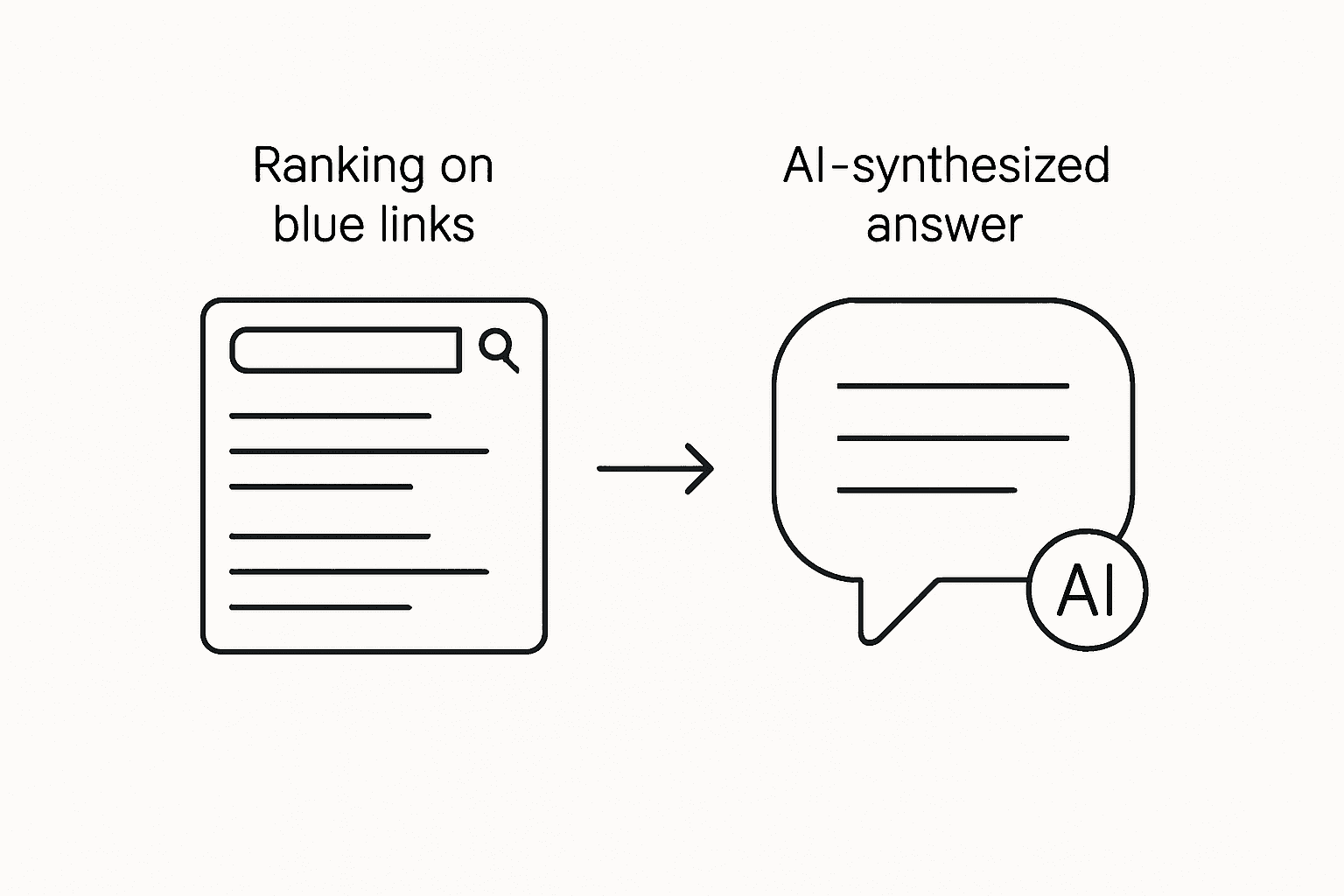
For two decades, SEO meant ranking on page one of a list of blue links. The goal was simple: get the click. But Google's AI Overviews, ChatGPT search, Perplexity, and a growing roster of AI-powered answer engines have rewritten the playbook. Today, a significant and growing share of searches end without a click — resolved by an AI-synthesized answer pulled from sources the algorithm deems most authoritative, structured, and relevant.
That shift has a name: Answer Engine Optimization (AEO). And if your content strategy hasn't accounted for it yet, you're already behind.
This guide gives you a clear, actionable framework for understanding AEO, why it matters for your marketing motion, and exactly how to optimize your content to be the source AI answers cite.
What Is Answer Engine Optimization (AEO)?
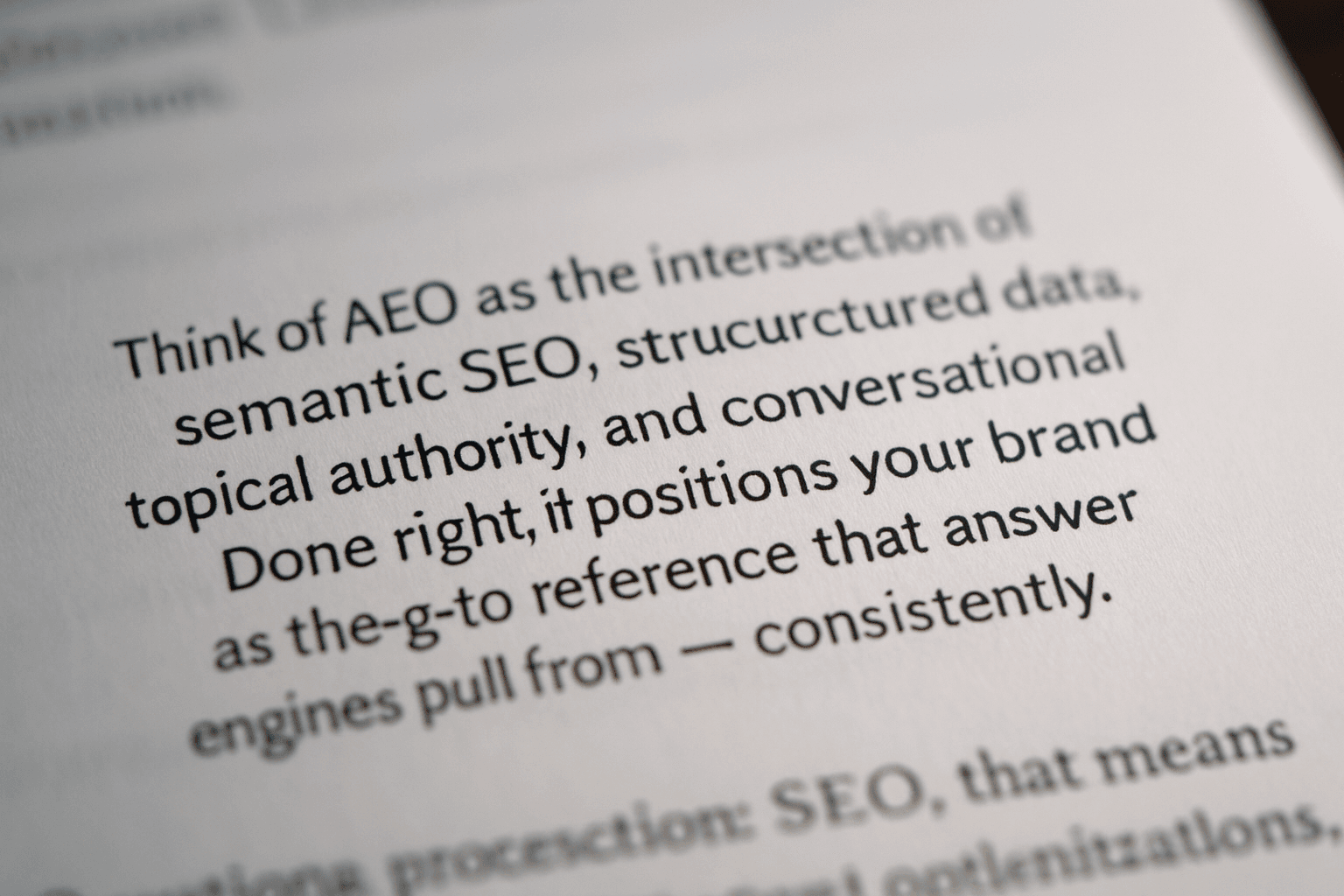
Answer Engine Optimization is the practice of structuring and positioning your content so that AI-powered search systems — Google's AI Overviews (formerly SGE), ChatGPT, Perplexity, Gemini, and others — surface it as the authoritative answer to a user's query.
Traditional SEO optimizes for ranking. AEO optimizes for being cited.
The distinction matters. In a zero-click search environment, the "winner" isn't necessarily the page that gets the most clicks — it's the source that gets quoted, paraphrased, or linked inside an AI-generated response. That still drives brand authority, trust signals, and qualified traffic. But it requires a fundamentally different content approach.
Why AEO Is Now a Core Marketing Priority
The numbers make the case plainly.
Google's AI Overviews now appear on a significant portion of search results pages, particularly for informational and commercial-intent queries — exactly the territory where B2B and SaaS marketers have historically invested the most content effort. Studies tracking click-through rates since AI Overviews rolled out broadly have shown measurable declines in organic CTR for positions 1–3 when an AI Overview is present.
At the same time, AI-native search tools are gaining traction with professional and technical audiences. Marketing managers, founders, and agency leads — the exact professionals you're trying to reach — are increasingly using tools like Perplexity and ChatGPT to research vendors, strategies, and solutions before they ever visit a brand's website.
The implication is clear: if your content isn't structured to be cited by these systems, you're invisible at the moment of highest intent.
AEO isn't a replacement for traditional SEO. It's a necessary layer on top of it — and the sooner it's integrated into your content operations, the larger the compounding advantage.
How AI Answer Engines Actually Work
Before you can optimize for AI-powered search, you need to understand how these systems make citation decisions.
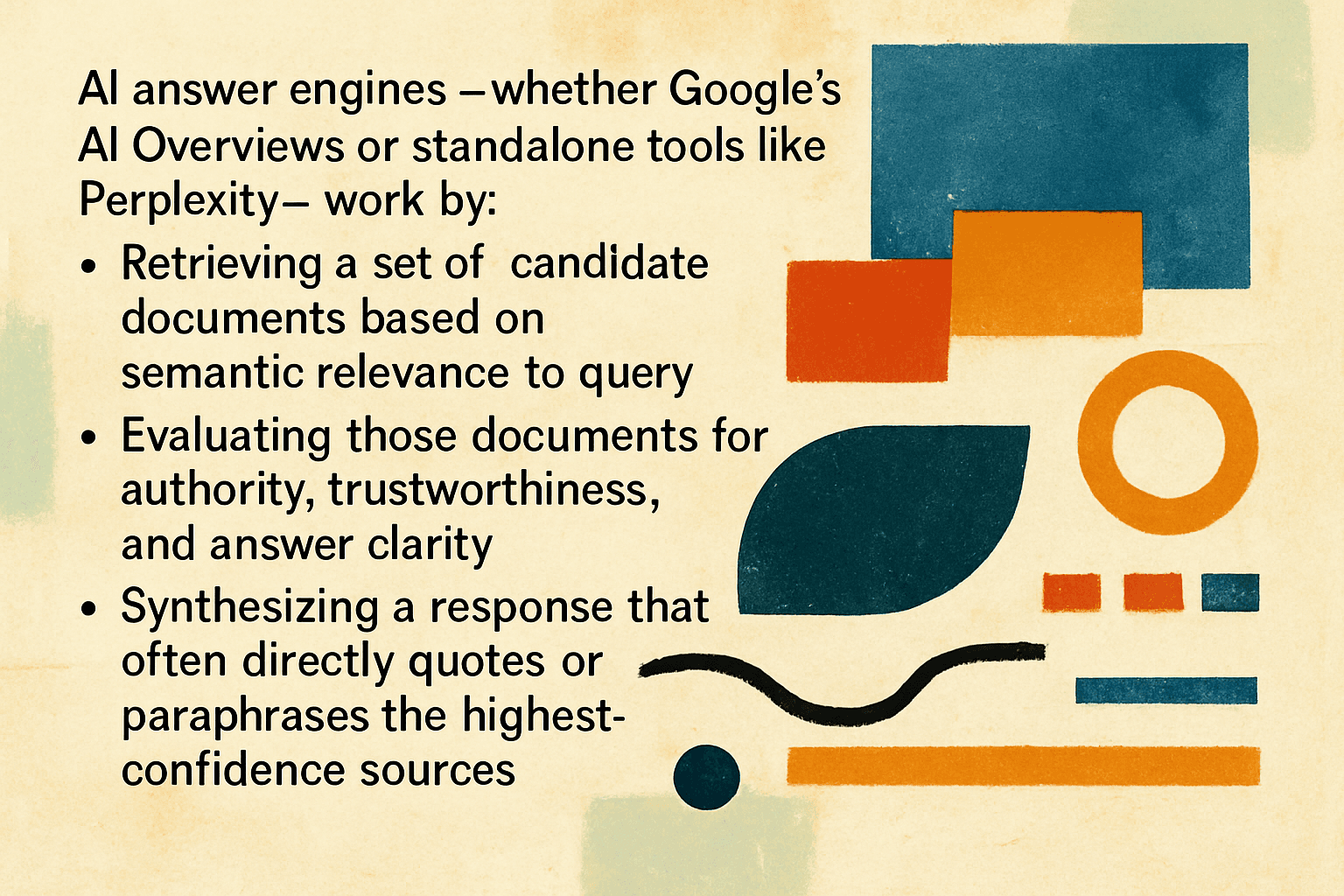
What this means for you: the systems are looking for content that is clearly structured, semantically precise, factually grounded, and directly responsive to user intent. They reward content that answers a question completely in a localized section — not content that buries the answer in narrative prose after three paragraphs of preamble.
This is a meaningful departure from the keyword-stuffing and meta-tag era of SEO. Generative AI SEO is fundamentally about deserving to be cited, not gaming a ranking signal.
The Core AEO Strategy Framework
1. Build Topical Authority, Not Just Individual Posts
AI systems evaluate the depth of your coverage on a subject, not just whether a single page is well-optimized. A site with five thin posts on "content marketing" will lose to a site with a comprehensive pillar page, supporting cluster content, and internal linking that demonstrates genuine domain expertise.
What to do:
Map your content to topic clusters with a clear pillar page for each core subject area
Ensure your clusters cover the full spectrum of user questions — from definitional ("what is X") to evaluative ("X vs. Y") to implementation-focused ("how to X")
Use internal linking deliberately to signal topical relationships to both search engines and AI crawlers
2. Structure Content to Answer Questions Directly
This is the single highest-leverage change most content teams can make. AI systems extract answers from content that is organized around questions and direct responses.
What to do:
Use FAQ sections with H3 headers phrased as actual questions users ask
Lead answers with a direct response in the first sentence — don't front-load context before the answer
Keep answer paragraphs tight: 2–4 sentences that fully address the question, followed by optional supporting detail
Use numbered lists for processes, bullet points for attributes, and tables for comparisons — structured formats are dramatically easier for AI to parse and cite
3. Optimize for Semantic SEO, Not Just Keyword Matching
Semantic SEO means building content around concepts and intent, not just keyword strings. Modern AI search understands natural language well enough to recognize whether your content genuinely covers a topic or just repeats a phrase.
What to do:
Research the full vocabulary around your topic: related terms, subtopics, common questions, and expert terminology
Use your primary keywords naturally within semantically rich context — avoid repetitive insertion
Address related concepts that users exploring your topic would also care about; this signals depth to AI systems
Include your target keywords in headings, the introduction, and conclusion, but prioritize coherent expert coverage over density
4. Implement Structured Data (Schema Markup)
Schema markup is machine-readable metadata that tells search engines — and AI systems — exactly what type of content a page contains and what it's about. It's one of the clearest signals you can send to an answer engine.
What to do:
Add
FAQPageschema to any page with a FAQ sectionUse
ArticleorBlogPostingschema on editorial content with accurate author and date metadataImplement
HowToschema for step-by-step guidesAdd
OrganizationandWebSiteschema to your home and about pages to establish entity recognition
5. Establish E-E-A-T Signals Across Your Site
Google's quality evaluator framework — Experience, Expertise, Authoritativeness, Trustworthiness (E-E-A-T) — has become even more critical in the AI Overview era. These systems are trained to prioritize sources that demonstrate genuine credibility.
What to do:
Create clear author profiles with verifiable credentials and social links
Build backlinks from authoritative industry sources — third-party citations remain a powerful trust signal
Keep your content factually accurate and up to date; outdated information is a reliability red flag for AI systems
Include original data, direct quotes from practitioners, and first-hand perspective where possible — these are signals of experience that AI systems are increasingly trained to recognize
6. Target Conversational and Long-Tail Queries
AI search skews heavily toward natural language queries. Users ask answer engines questions the way they'd ask a knowledgeable colleague — in full sentences, with context. Your content needs to match that register.
What to do:
Conduct keyword research specifically targeting question-format queries: "how does X work," "what is the difference between X and Y," "best way to X for [specific context]"
Use tools like AlsoAsked, AnswerThePublic, and the "People Also Ask" sections in Google results to map the full question landscape around your topics
Write conversational subheadings that mirror how users phrase queries — this dramatically increases the likelihood of being matched to a specific intent
7. Optimize for Featured Snippets — They Feed AI Overviews
Featured snippets and AI Overviews share significant content overlap. Pages that already rank for featured snippets are disproportionately represented in AI-generated answers. Optimizing for one effectively optimizes for both.
What to do:
Identify queries where your content could plausibly earn a featured snippet (typically definitional, comparison, or step-based queries in positions 2–10)
Structure the relevant section with a direct 40–60 word definition or summary immediately following the H2
Use the exact question as a subheading when natural
Tables, numbered lists, and clean paragraph snippets all have strong featured snippet and AI citation rates
Common AEO Mistakes to Avoid
Even well-intentioned content teams make these errors when shifting to an AEO strategy:
Burying the answer: Starting every section with context and background before getting to the actual answer. Lead with the answer, then add nuance.
Neglecting structured data: Schema markup is still dramatically underused, especially on blog content. It's a high-ROI implementation for most sites.
Ignoring page speed and Core Web Vitals: AI systems still rely on Google's index as a foundation. Pages that don't pass technical performance benchmarks are harder to crawl and index reliably.
Creating content without topical depth: A single well-optimized post won't establish topical authority. You need coverage, not just one good page.
Over-indexing on volume at the expense of quality: In the AI era, thin content is actively counterproductive. One authoritative 2,000-word guide outperforms ten 400-word posts on the same topic.
Measuring AEO Performance
AEO introduces some measurement complexity because AI-generated answers don't always produce a trackable click. Here's how to build a functional measurement approach:
Track branded search volume trends: As your brand gets cited in AI answers, branded search volume tends to increase over time. This is a leading indicator of AEO impact.
Monitor AI Overview appearances: Tools like SE Ranking, Semrush, and Ahrefs are building AI Overview tracking features — monitor which of your pages appear in AI-generated responses.
Watch for position 0 / featured snippet ownership: As noted, featured snippets and AI citations are closely correlated. Track your featured snippet rate as a proxy metric.
Analyze organic CTR by query type: If AI Overviews are appearing for your target queries, expect CTR to shift. Track impressions separately from clicks in Google Search Console to understand actual visibility trends.
Brand mention monitoring: Use tools like Brand24 or Mention to track when your brand name appears in AI-generated answers shared on social platforms or in newsletters.
AEO and Your Broader Marketing Motion
AEO doesn't exist in a vacuum. The same content discipline that earns AI citations — structured, authoritative, semantically rich, question-answering — is also the content that builds trust with human readers, earns shares, and converts at higher rates.
For lean marketing teams managing multiple channels, this is actually an efficiency argument: the investment in high-quality, well-structured content serves organic search, AI-powered search, social distribution, and lead generation simultaneously. It's the opposite of fragmented effort.
The teams who will dominate AI-powered search in the next 18 months aren't the ones producing the most content. They're the ones producing the most citable content — consistently, at scale, with a clear topical authority strategy behind it.
That's not a content volume problem. It's a content operations problem.
Conclusion: AEO Is the New SEO Foundation
The shift to AI-powered search is not a future trend — it's the current operating environment. Answer Engine Optimization is how you adapt your content strategy to earn visibility in a landscape where the first answer a user sees may never send them to a results page at all.
The core principles are straightforward: build topical authority, answer questions directly, implement structured data, demonstrate E-E-A-T, and optimize for the conversational queries your audience is already asking. Execute these consistently and you build a compounding advantage that traditional keyword-chasing can't replicate.
The marketers who treat AEO as an optional upgrade will find themselves increasingly invisible at the moment of highest intent. The ones who systematize it as a core content discipline will own the AI answer layer — and the trust that comes with it.
Want more strategic guides like this? Subscribe to the Magikal newsletter for actionable frameworks on adapting your marketing motion for the AI era — delivered to your inbox before everyone else catches up.