Competitive intelligence used to mean spreadsheets, Google Alerts, and someone on your team manually scrolling competitor blogs every Friday afternoon. That era is over.
In 2026, AI competitive monitoring has become a strategic function — not a reactive chore. The teams winning market share aren't just watching their competitors more closely. They're watching them smarter, using AI to surface signals that manual processes simply can't catch at speed or scale.
This guide breaks down the tools, frameworks, and practical strategies that matter right now — whether you're a solo marketer, a lean growth team, or an agency managing multiple client landscapes.
Why Traditional Competitive Monitoring Is Failing Marketers
Most competitive monitoring programs have the same structural problem: they're backward-looking and labor-intensive.
A human researcher reviews competitor messaging, pricing pages, and ad libraries on a schedule. By the time insights reach the team that needs them, they're already stale. Worse, the sheer volume of signals — social mentions, content shifts, ad creative changes, SERP movements, review sentiment — is too large for any manual process to synthesize meaningfully.

The result is a monitoring program that generates noise, not intelligence.
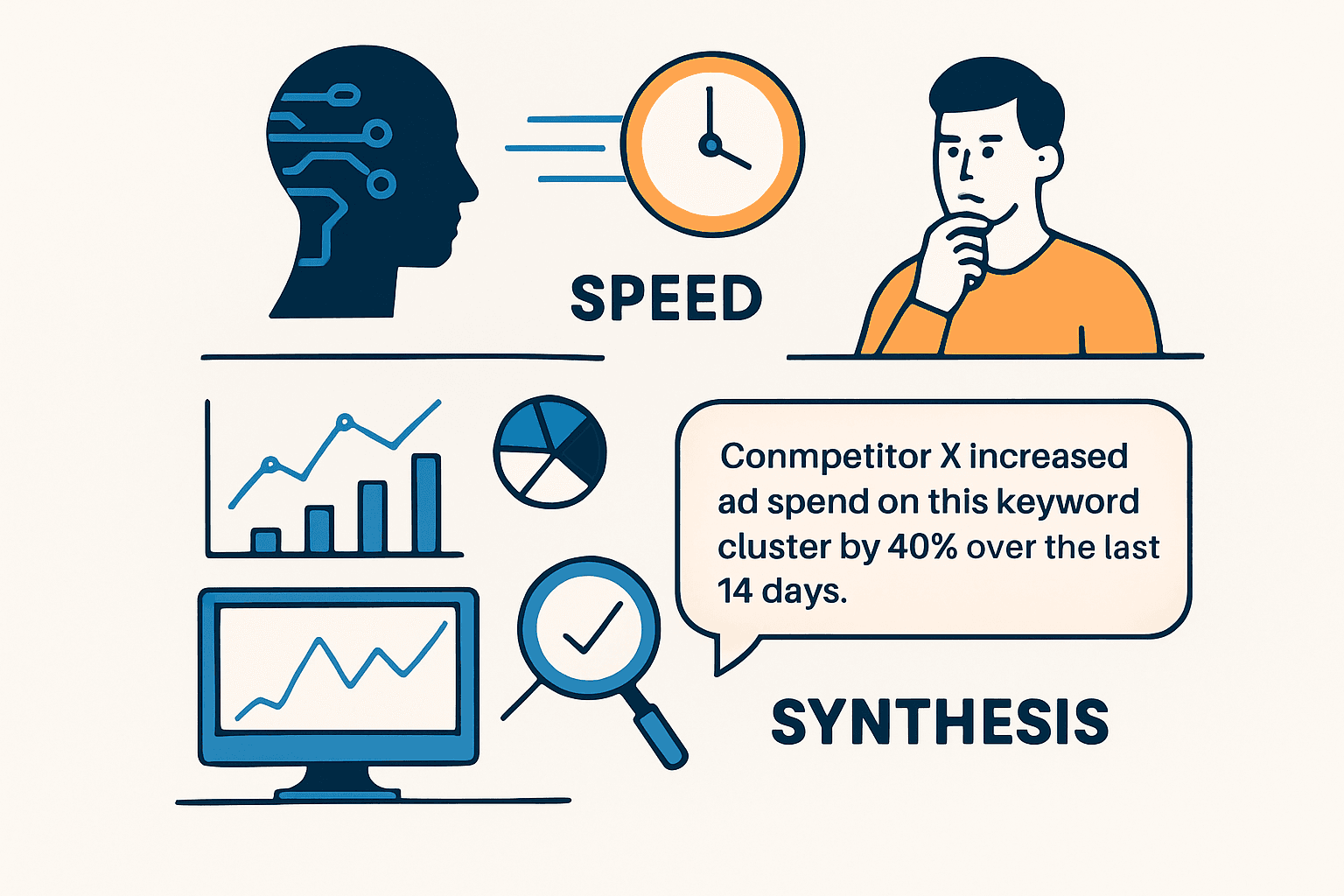
AI changes the equation in three specific ways:
Speed: AI can monitor hundreds of data sources simultaneously and flag meaningful changes in near real-time.
Pattern recognition: Machine learning identifies trends across signal types that would be invisible in siloed manual review.
Synthesis: Instead of raw data dumps, AI systems can surface actionable insights — "Competitor X increased ad spend on this keyword cluster by 40% over the last 14 days."
This is the foundation of a modern AI-powered competitor analysis program.
The Competitive Intelligence Stack: What's Actually Worth Using in 2026
The market for competitive intelligence tools AI has matured significantly. Here's how to think about the core layers of a functional stack.
1. AI-Powered SERP and Content Monitoring
Tools like Semrush, Ahrefs, and newer AI-native platforms now offer automated competitive content tracking that goes beyond keyword rankings. You can monitor when competitors publish new content targeting specific keyword clusters, track their backlink velocity, and receive alerts when they make significant structural changes to key pages.
What to look for: AI-driven anomaly detection — systems that tell you when something changed significantly, not just what it looks like today.
2. Ad Intelligence Platforms
Meta's Ad Library, combined with AI-powered ad intelligence tools like AdSpy or Pathmatics, gives you a real-time view of competitor creative strategy. In 2026, the most useful platforms apply AI to identify messaging themes, creative fatigue signals, and budget shift patterns — not just show you screenshots of ads.
What to look for: Platforms that categorize competitor ad creative by theme and track changes over time, not just current state.
3. Social Listening and Sentiment Analysis
AI-driven social listening has moved well beyond keyword tracking. Modern platforms like Brandwatch, Sprout Social's listening suite, and Talkwalker use NLP models to understand context, sentiment, and emerging conversation themes around competitors — including what customers are complaining about, which is often the most actionable signal of all.
What to look for: Sentiment trend analysis and topic clustering, not just mention volume.
4. Review and Customer Feedback Intelligence
Competitor review data on G2, Capterra, Trustpilot, and app stores is a goldmine of unfiltered customer intelligence. AI tools can aggregate and analyze this data at scale, identifying consistent pain points, unmet needs, and feature gaps that represent positioning opportunities for your brand.
What to look for: Tools that synthesize themes across hundreds of reviews, not just aggregate star ratings.
5. AI Research Assistants and Synthesis Layers
Increasingly, the most forward-thinking teams are using AI assistants — whether purpose-built competitive intelligence platforms or general large language models with structured workflows — to synthesize intelligence from across their stack into strategic briefs. This is where market intelligence AI moves from data collection to decision support.
What to look for: Systems that connect to your existing data sources and produce structured, actionable outputs — not just raw summaries.
Building Your AI Competitive Monitoring Strategy
Having tools is not a strategy. Here's how to build a program that actually drives decisions.
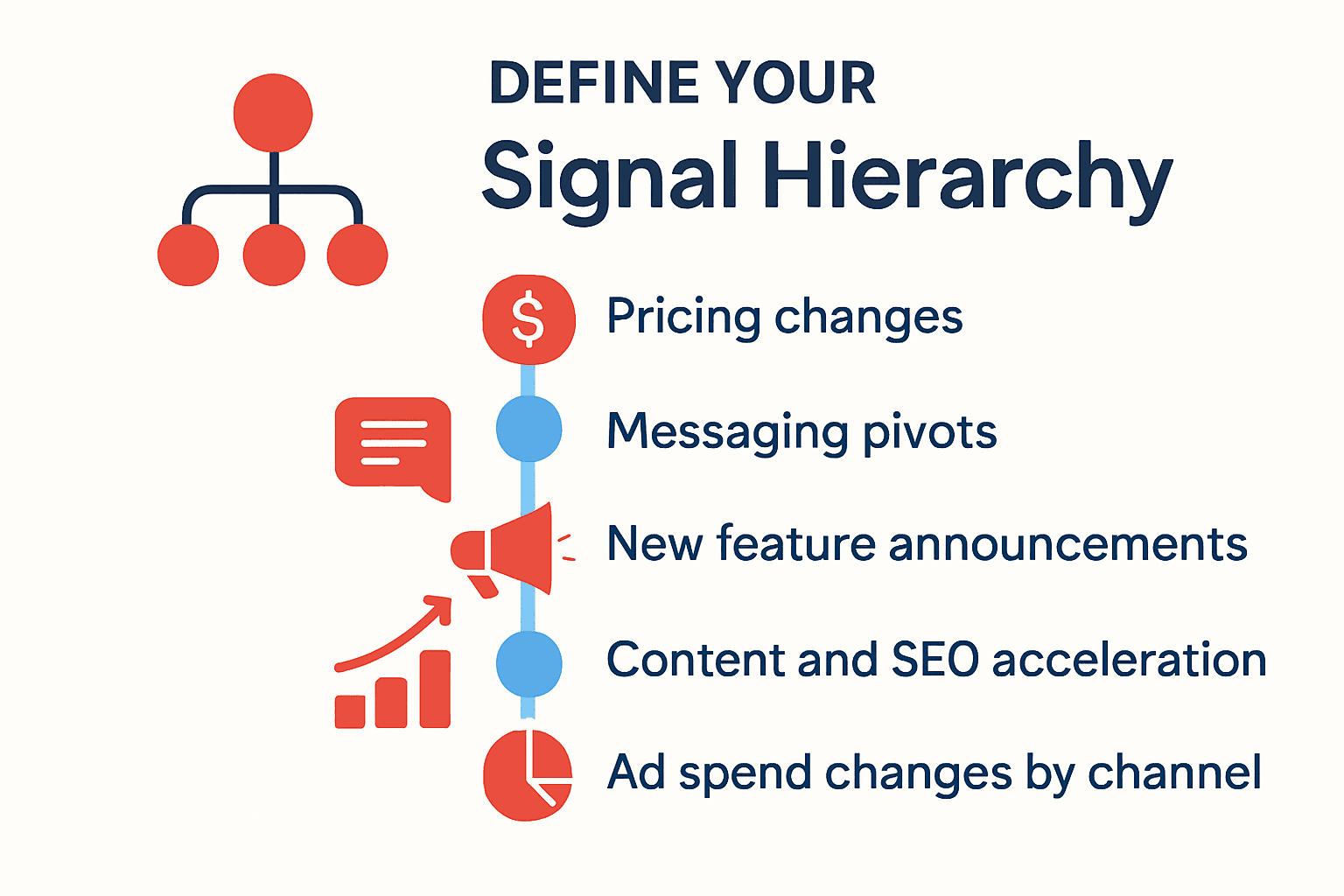
Your AI monitoring infrastructure should be tuned to surface these signals with priority weighting — not treat a competitor's new blog post with the same urgency as a pricing overhaul.
Create a Structured Intelligence Cadence
Ad hoc monitoring produces ad hoc insights. Build a rhythm:
Daily: Automated AI alerts for high-priority signals (pricing changes, major product announcements, significant SERP shifts)
Weekly: AI-synthesized briefing covering ad creative changes, content movements, and social sentiment shifts
Monthly: Deeper competitive landscape review — messaging evolution, SEO trajectory, positioning gaps and opportunities
This cadence ensures competitive intelligence flows into decisions at the right intervals — not all at once when someone finally has time to check.
Connect Intelligence to Content and Positioning
The most common failure mode in competitive monitoring: the intelligence never reaches the people who need it. Your content team doesn't know a competitor just launched a campaign on your highest-converting keyword cluster. Your product marketing team doesn't know customers are publicly frustrated with a competitor's onboarding experience.
Build explicit feedback loops:
Competitive insights should feed directly into content planning (what gaps can you own?)
Messaging changes from competitors should trigger a positioning review
Identified customer pain points in competitor reviews should inform your differentiation narrative
Use AI to Model "What Comes Next"
The most sophisticated digital marketing competitive strategy in 2026 isn't just reactive — it's predictive. Modern AI systems can analyze competitor trajectory patterns to anticipate moves: when they're likely to expand into a new content area, when their ad spend patterns suggest a product launch is coming, when sentiment shifts signal a retention problem you can capitalize on.
This is where AI marketing strategy becomes a genuine competitive weapon, not just an operational efficiency.
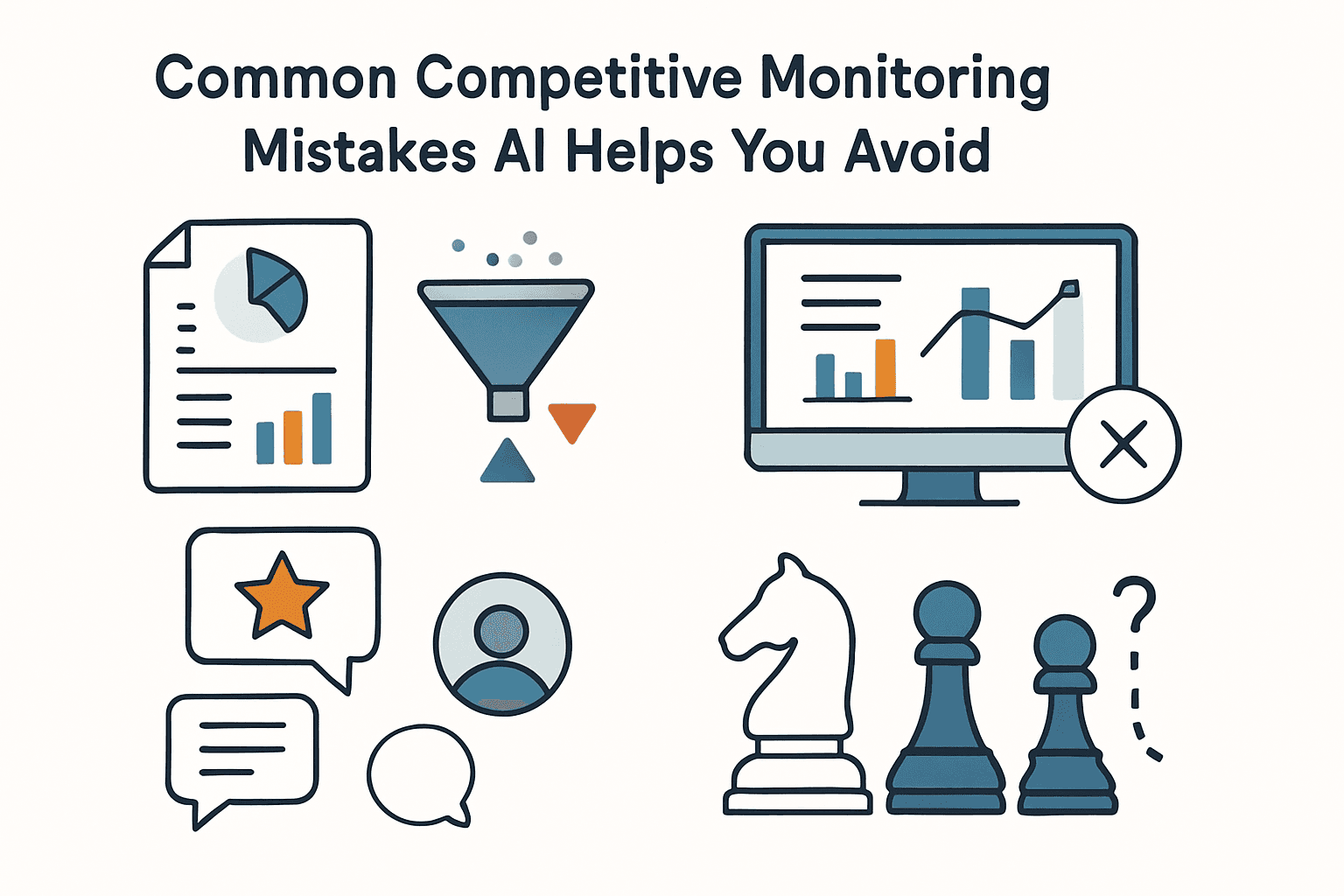
Common Competitive Monitoring Mistakes AI Helps You Avoid
Monitoring too broadly. AI helps you filter and prioritize — but only if you define your signal hierarchy first. Garbage in, garbage out still applies.
Treating monitoring as a reporting function. Intelligence that doesn't change decisions is just expensive noise. Every monitoring cadence should have a defined decision path: if we see X, we do Y.
Ignoring the customer conversation. Your competitors' customer reviews are a direct window into unmet needs. This is consistently under-leveraged and easy to capture with AI sentiment analysis.
Benchmarking only direct competitors. The future of competitive analysis includes tracking adjacent market players and emerging entrants that could reshape your category before they're on your radar.
The Unified Intelligence Advantage
There's a growing gap between teams using disconnected point solutions for competitive monitoring and those running it through a unified AI system that connects intelligence to execution.
When your competitive signals are siloed in separate tools, synthesis requires human intervention at every step. When they flow through a unified AI layer that also understands your brand positioning, content strategy, and performance data, the system can close the loop automatically — surfacing the right intelligence at the right moment and connecting it to the right action.
This is the direction the competitive intelligence AI space is heading: not more tools, but more connected intelligence.
Conclusion: Intelligence That Drives Action
Competitive monitoring in 2026 is not about watching your competitors more — it's about understanding the landscape more clearly so your strategic decisions are better informed, faster, and more precise.
The teams with the advantage are those who've moved from manual, reactive monitoring to AI-driven, cadenced intelligence programs that feed directly into content, positioning, and growth strategy.
The tools exist. The strategies are proven. The question is whether your current monitoring program is built for the speed and complexity of today's market.
Evaluate your current competitive monitoring strategy against these AI-driven approaches. Identify your signal hierarchy, close the gaps in your intelligence stack, and consider how a unified AI system — one that connects market intelligence to your content and marketing motion — could fundamentally sharpen your competitive edge.
The market isn't standing still. Your intelligence program shouldn't either.